
7 Costly Mistakes to Avoid with Van Graphics: A 2026 West Midlands Business Guide
- Usama Saghar
- May 26
- 12 min read

A bad van wrap is worse than no wrap at all. It's a high-speed drain on your marketing budget that erodes trust every time you hit the road. You want a mobile billboard that builds authority, not a peeling eyesore that makes your business look second-rate. It's a common fear. You worry about graphics bubbling or a design that's impossible to read at 50mph. You need results. You need precision.
Stop wasting money on poor signage. You can secure a high-impact transformation and a 5-year ROI by dodging the critical mistakes to avoid with van graphics. This guide delivers the technical and design roadmap you need to dominate the West Midlands. We'll dive into premium cast vinyl specs, 2026 DVLA notification rules for color changes, and the latest tachograph regulations for light commercial vehicles. It's time to turn your fleet into a precision marketing machine that outshines every local competitor. Let's move.
Key Takeaways
Master the "Three Second Rule" to ensure your branding stays legible and impactful at high speeds on the A461.
Learn the technical difference between cheap monomeric vinyl and premium cast films to protect your long-term ROI.
Discover the critical mistakes to avoid with van graphics when designing around vehicle hardware like sliders, handles, and ADAS sensors.
Protect your investment by avoiding high-pressure jet washers and automated car washes that act as "vinyl peelers."
Leverage 30 years of Aldridge expertise to transform your fleet into a high-performance mobile billboard that generates leads.
Table of Contents
The "Invisible" Van: Design Mistakes That Kill Your Local ROI
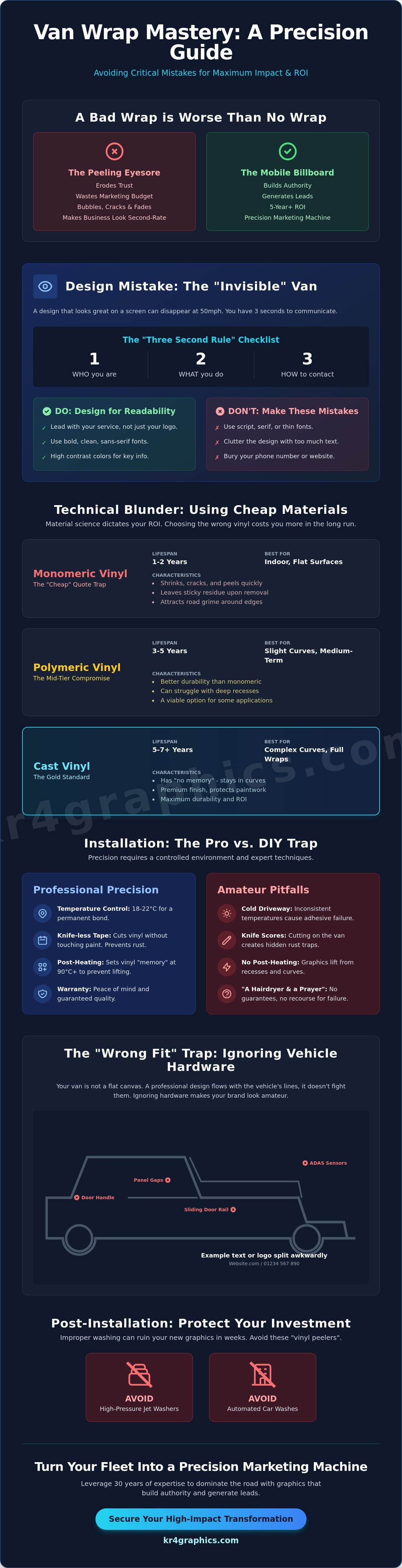
A design that looks stunning in a boardroom often vanishes on the M6. Digital mock-ups are static; real-world marketing is kinetic. When you are cruising down the A461, your audience isn't leaning in to study your brand. They are navigating traffic. One of the biggest mistakes to avoid with van graphics is designing for a monitor rather than a motorway. You have exactly three seconds. That is the "Three Second Rule" of mobile advertising. If a commuter cannot identify who you are, what you do, and how to contact you in that window, your investment is invisible.
Many businesses fall into the trap of "Logo-Centricity." They splash a massive, abstract logo across the side panel but leave the actual service in small font at the bottom. Unless you are Amazon or Nike, your service is more important than your symbol. A vehicle vinyl wrap should act as a lead generator. Lead with your solution. Follow with your name. Understanding the visual physics of a moving vehicle helps you identify common mistakes to avoid with van graphics before you commit to print.
Font Fails and Readability Disasters
Script and serif fonts are the enemies of legibility. While a thin, elegant script looks sophisticated on a business card, it turns into a blurred line at
Technical Blunders: Why Cheap Materials Cost You More
Don't be fooled by the lowest bid. It's a trap. A "cheap" quote usually hides inferior materials that fail before your first MOT. One of the most expensive mistakes to avoid with van graphics is choosing monomeric vinyl for a vehicle that lives outdoors. This material is designed for flat shop windows, not the complex curves of a Ford Transit. When you are marketing to consumers in their cars, you need your brand to look sharp for years, not months. High-quality UV laminates are the only thing standing between your vibrant brand colors and the corrosive effects of British road salt and acid rain.
Monomeric vs. Polymeric vs. Cast Vinyl
Material science dictates your ROI. Monomeric vinyl is the entry-level choice, offering a lifespan of barely 12 to 24 months in the West Midlands climate. It shrinks. It cracks. It leaves a sticky black residue around the edges that attracts road grime. Polymeric vinyl is a mid-tier step up, lasting 3 to 5 years, but it still struggles with deep recesses. For a professional finish, Cast vinyl is the gold standard. It is manufactured to have "no memory," meaning once it is heat-set into a curve, it stays there. Choosing the wrong grade is one of the primary mistakes to avoid with van graphics because cheap vinyl often bonds too aggressively to the clear coat. When you try to remove it, it takes your paintwork with it.
The DIY and "Man with a Van" Installation Trap
Precision requires a controlled environment. If your installer is working in a drafty warehouse or on a cold driveway, the graphics are doomed. Vinyl requires a consistent temperature of 18 to 22 degrees Celsius to achieve a permanent bond. Amateurs often "knife-score" the paintwork while trimming the vinyl, creating hidden rust traps that devalue your vehicle. Professional van sign writing graphics involve more than just sticking stickers. It is a technical process of surface decontamination, heat-forming, and post-heating to ensure the adhesive cures correctly.
Temperature Control: Clinical conditions prevent adhesive failure and bubbling.
Knife-less Tape: Professional installers use specialized filaments to cut vinyl without touching your paint.
Post-Heating: Setting the vinyl's "memory" at 90°C+ ensures it never lifts from recesses.
A professional installation comes with a warranty. A DIY job comes with a hairdryer and a prayer. Protect your fleet and your brand by demanding technical excellence from the start.
The "Wrong Fit" Trap: Ignoring Vehicle Features and Layout
Your van is not a flat canvas. It is a complex machine built with hinges, handles, sliding doors, and fuel caps. One of the most frustrating mistakes to avoid with van graphics is treating a 3D vehicle like a 2D sheet of paper. When your phone number is bisected by a sliding door rail or your website URL is swallowed by a fuel cap, your professional image takes a hit. Precision matters. You need a design that flows with the vehicle's lines, not one that fights them. If your graphic designer hasn't seen your specific van model in person, you are gambling with your brand.
Modern vehicles in 2026 are more technical than ever. Ignoring ADAS (Advanced Driver Assistance Systems) cameras and parking sensors is a critical error. Covering these sensors with vinyl can disable safety features or cause constant dashboard warnings. A professional layout respects the tech. It ensures your branding is high-impact without compromising the vehicle's operational safety. We see "off-the-shelf" templates fail daily because they don't account for mid-generation trim changes or aftermarket deadlocks. Real-world measurements beat digital templates every time.
Designing Around Obstructions
The "Critical Zone" is the area on your van where the most important information must live. This is usually the upper third of the side panels and the rear doors at eye level. One of the primary mistakes to avoid with van graphics is placing text across panel gaps. Over time, the constant opening and closing of doors causes friction that peels the vinyl edges. Smart design places text in the center of panels. It uses negative space to navigate around door handles and hinges. This prevents the "unfortunate cut" where a handle or lock ends up right in the middle of your company name or a person's face in a photographic wrap.
Fleet Scalability and Model Variations
Consistency is the hallmark of a professional fleet. However, a design that works on a Long Wheelbase (LWB) Ford Transit will look cluttered and cramped if you simply shrink it for a Citroen Berlingo. You must adapt the layout for every vehicle size while keeping the core brand elements identical. This is vital for West Midlands businesses running mixed fleets. Integrating high-quality vehicle graphics requires a strategic approach to scale. You might need to move a logo or adjust the weight of the font to ensure the Berlingo looks just as authoritative as the Transit. Whether you are adding Chapter 8 chevron kits for site safety or full wraps for maximum visibility, every inch must be accounted for.
Panel Gaps: Keep critical text at least 50mm away from any door edge or seam.
ADAS Sensors: Never apply vinyl over cameras, radar housings, or ultrasonic sensors.
Fuel Caps: Ensure the design allows for easy access without catching the vinyl edge during every fill-up.
A unified fleet builds massive local trust. Don't let a layout error turn your mobile billboard into a confusing mess. Focus on the fit, and the results will follow.
Post-Installation Failures: How to Ruin Your Graphics in 30 Days
You have secured the transformation. Your brand looks elite. Now, you must protect the investment. One of the most common mistakes to avoid with van graphics happens within the first thirty days of ownership. Many business owners treat a freshly wrapped vehicle like a standard paint job. It isn't. Vinyl is a high-performance film that requires specific care to reach its five-year potential. If you ignore the maintenance protocol, you are effectively throwing your marketing budget into a high-pressure jet wash.
Automated car washes are the ultimate brand killers. The rotating brushes are too abrasive for even the highest-quality laminates. They create micro-scratches that trap road grime and dull your vibrant colors. Worse, they snag the edges of vinyl cut lettering. High-pressure jet washers are equally dangerous. If used at close range, they act as precision peelers. They force water under the adhesive at the seams, causing immediate lifting. In the West Midlands, where road salt and industrial fallout are constant threats, these errors are magnified. Don't let a ten-pound car wash ruin a thousand-pound investment.
The "Curing" Period: The First 72 Hours
The first three days are critical. The adhesive needs time to fully outgas and bond to the substrate. Do not wash the van during this window. Avoid extreme temperature shifts, such as moving the vehicle from a heated garage to a freezing driveway. Parking under trees is another risk. Bird lime and tree sap are highly acidic. On fresh vinyl, they can cause permanent staining before the laminate has fully stabilized. One of the primary mistakes to avoid with van graphics is rushing the first clean before the bond is permanent.
Correct Cleaning Protocols for Wrapped Vans
Preserving your finish requires the "Two-Bucket" hand wash method. Use one bucket for soapy water and one for rinsing your mitt. This prevents you from rubbing abrasive grit back into the vinyl. Avoid solvent-based cleaners, kitchen detergents, or abrasive sponges. These chemicals dissolve the adhesive and scratch the protective UV layer. Stick to pH-neutral soaps to keep your fleet looking sharp. If you want a partner who understands the long-term lifecycle of your branding, consult the experts at KR Graphics for precision-fitted solutions that actually last.
No Brushes: Avoid all mechanical car washes. Hand wash only.
Salt Removal: Rinse the van frequently in winter to prevent road salt from eating the edges.
Heat Warning: Keep jet wash nozzles at least 30cm away from any vinyl edge.
Precision maintenance is the final step in your brand's transformation. Treat your graphics with respect, and they will generate leads for years to come.
The KR Graphics Advantage: Precision Branding in Aldridge
Experience is the ultimate filter. In Aldridge, KR Graphics has spent over 30 years refining the art of vehicle branding. We've seen every one of the mistakes to avoid with van graphics play out on the local roads. We know why some wraps fail on the M6 and why others generate leads for half a decade. This isn't just about sticking vinyl to a panel. It's about technical engineering. It's about precision. We operate a high-octane production line where speed never compromises quality. Every vehicle that enters our bay undergoes a total transformation.
Our end-to-end process eliminates the guesswork. We move from technical design to climate-controlled fitting with clinical efficiency. We specialize in high-impact full vehicle wraps and complex fleet branding. We ensure your livery complies with all 2026 UK road standards. This includes the latest DVLA color notification rules and safety markings for light commercial vehicles. We don't just provide a service. We act as a catalyst for your brand's growth.
The KR Graphics Consultation Process
Success begins before the first roll of vinyl is cut. Our free artwork consultation identifies the design errors that kill ROI before they reach the printer. We don't use generic templates. We measure. We analyze. We select materials tailored to your specific vehicle usage and budget. Whether you need a high-durability cast wrap for a long-distance fleet or vinyl lettering for a local runaround, we match the tech to the task. Our goal is a lead-generating visual solution that withstands the West Midlands climate for 5+ years.
Beyond the Van: A Total Signage Partner
Your brand needs a unified voice. A high-impact van wrap loses its power if your physical site looks dated. We integrate your vehicle livery with pvc banners and shop front signage to create a seamless visual identity. From built-up 3D letters to window frosting, we ensure your shop front and your fleet speak the same language of professional competence. We turn every physical asset into a powerful marketing tool. Don't settle for "good enough" when you can have precision-engineered excellence.
Trade Heritage: 30+ years of local expertise in Aldridge.
Technical Precision: Climate-controlled fitting bays for perfect adhesion.
Strategic Growth: Visual solutions designed to beat local competitors.
Stop wasting your marketing budget on poor signage. Learn the technical pitfalls and get it right the first time. Ready to transform your van? Contact KR Graphics in Aldridge today and let's build something massive.
Drive Your Brand Transformation Forward
Your van is more than transport. It's a high-performance marketing engine. By mastering the technical nuances of material selection and respecting the "Three Second Rule" of mobile design, you turn a depreciating asset into a lead-generating powerhouse. You now know the critical mistakes to avoid with van graphics. From choosing premium cast films over cheap alternatives to protecting your wrap from aggressive jet washes, the path to a 5-year ROI is clear. Precision pays. Cutting corners costs.
Don't leave your reputation to chance. KR Graphics brings over 30 years of industry experience to every project. We are specialists in full and partial wraps, operating from our precision-focused facility in Aldridge. We serve the entire West Midlands with a commitment to durability and high-octane visual impact. We understand the science of the wrap and the strategy of the sale. It's time to turn your fleet into a dominant force on the road.
Ready to elevate your professional image?Get a High-Impact Van Graphics Quote from KR Graphics today. Let's build a brand that outlasts the competition and drives your business growth.
Frequently Asked Questions
How long do van graphics typically last in the UK?
High quality cast vinyl graphics typically last 5 to 8 years in the UK climate. Premium materials like 3M 2080 or Avery Dennison MPI 1105 are engineered for extreme durability against UV exposure and corrosive road salt. Cheaper monomeric films often fail within 12 to 24 months. Regular maintenance and correct cleaning protocols are essential to reaching the maximum lifespan of your investment. Precision materials deliver long term value.
Can I put my van through a car wash with vinyl graphics?
No, you should avoid automated car washes with rotating brushes as they can scratch the laminate and lift the edges of your graphics. Hand washing with the "Two Bucket" method is the only way to preserve the high octane finish. High pressure jet washers can also act as vinyl peelers if used too closely. Keep the nozzle at least 30cm away from any seams or edges. Protect your brand. Wash by hand.
What happens if I need to change my phone number on the van?
You can easily update specific details like phone numbers without replacing the entire wrap. Vinyl cut lettering is designed for modular updates. We remove the outdated digits using controlled heat and apply new graphics in their place. This is a cost effective way to keep your fleet current as your business evolves. It is one of the common mistakes to avoid with van graphics to think you need a total re wrap for minor text changes.
Will van graphics damage my original paintwork when removed?
Professional grade cast vinyl protects your original paintwork from stone chips and UV fading rather than damaging it. The film acts as a sacrificial layer. However, damage can occur if you use low quality monomeric vinyl which bonds too aggressively over time. If the paint was in good condition and factory original before installation, the vinyl should pull away cleanly when removed by a professional using the correct heat techniques. Transformation should be reversible.
Do I need to tell my insurance company about my van wrap?
Yes, you must notify your insurance provider because a wrap is considered a vehicle modification. Failure to disclose this could void your policy in the event of a claim. Most insurers view it as a change to the vehicle appearance rather than a performance upgrade, but they still require it on record. Additionally, if the wrap changes the primary color, you are legally required to update your V5C logbook with the DVLA. Stay legal. Stay covered.
How much does it cost to fix a single damaged panel on a wrap?
Fixing a single panel is a straightforward process that involves removing the damaged section and printing a color matched replacement. Because we keep your digital artwork on file, we can quickly reproduce the exact segment needed. This modular approach ensures your fleet stays on the road looking sharp without the expense of a full re install. It is a strategic way to maintain your professional image without breaking the budget. Precision repairs save money.
Can you apply graphics to a van with existing rust or scratches?
Vinyl graphics require a smooth, decontaminated surface to bond correctly. Applying film over rust or deep scratches is a recipe for failure. The vinyl will not adhere to oxidized metal, and any trapped moisture will accelerate the corrosion underneath. We recommend repairing any bodywork damage before installation. A wrap is a transformation tool, not a way to hide structural decay. Start with a clean canvas for a high quality result.
How do I know if my van needs a full wrap or just simple lettering?
Your choice depends on your marketing goals and budget. Full van wraps offer maximum brand impact and protection for your paintwork, turning the entire vehicle into a high visibility billboard. Simple vinyl cut lettering is ideal for basic contact details and a minimalist look. If you want to dominate the West Midlands market, a full or partial wrap is the strategic choice to beat local competitors. Identifying your specific needs helps you navigate the common mistakes to avoid with van graphics.


Comments