
Why Is My Van Wrap Peeling? The Hard Truth About Vehicle Graphic Failure
- Usama Saghar
- May 28
- 12 min read

A peeling van wrap isn't just a cosmetic glitch. It's a loud, visible signal that your brand's first impression is falling apart. You invested in a mobile billboard to drive growth, but now you're left wondering why is my van wrap peeling after only a few months. It's frustrating to see edges lift and graphics bubble when you expected a high-impact transformation. You shouldn't have to choose between a professional image and a functional fleet.
We know that tatty graphics represent a wasted marketing budget and unnecessary downtime. You deserve a wrap that reflects your company's precision and scale. This article uncovers the technical reasons behind lifting, from poor surface preparation to the physics of overstretched vinyl. We'll explore why high-quality cast films like the 3M 2080 series are essential for achieving the industry-standard five to seven year lifespan. You will learn how to determine if your wrap is salvageable and how to find a reliable partner who treats your branding as a strategic investment. Let's turn your vehicle back into a powerful marketing tool that stands the test of time.
Key Takeaways
Identify the "invisible killers" of vehicle graphics, from microscopic surface grease to low surface energy on modern paintwork.
Master the difference between high-performance cast and cheaper calendered materials to ensure your next branding investment survives the rigours of the road.
Determine when a strategic patch can save your graphics and why edge sealers rarely provide a permanent fix for failed vinyl.
Learn how professional, engineering-led installation techniques specifically combat the UK's harsh climate, road salt, and frost to guarantee durability.
Table of Contents
The Physics of Failure: Why Van Wraps Peel and Lift
A high-quality Vehicle vinyl wrap is a precision-engineered marketing asset. It is not just a sticker. When you see your branding start to curl, you are witnessing a direct battle between chemical bonds and physical tension. Edge lifting is the primary failure point. It marks the moment the adhesive loses its grip on the substrate. This often stems from surface energy issues. Modern automotive paints and textured plastics are designed to be non-stick for dirt and water. If the installer hasn't accounted for this low surface energy, the vinyl cannot form a permanent bond. The result? A professional image that quickly looks like a liability.
Tension and the Snap-Back Effect
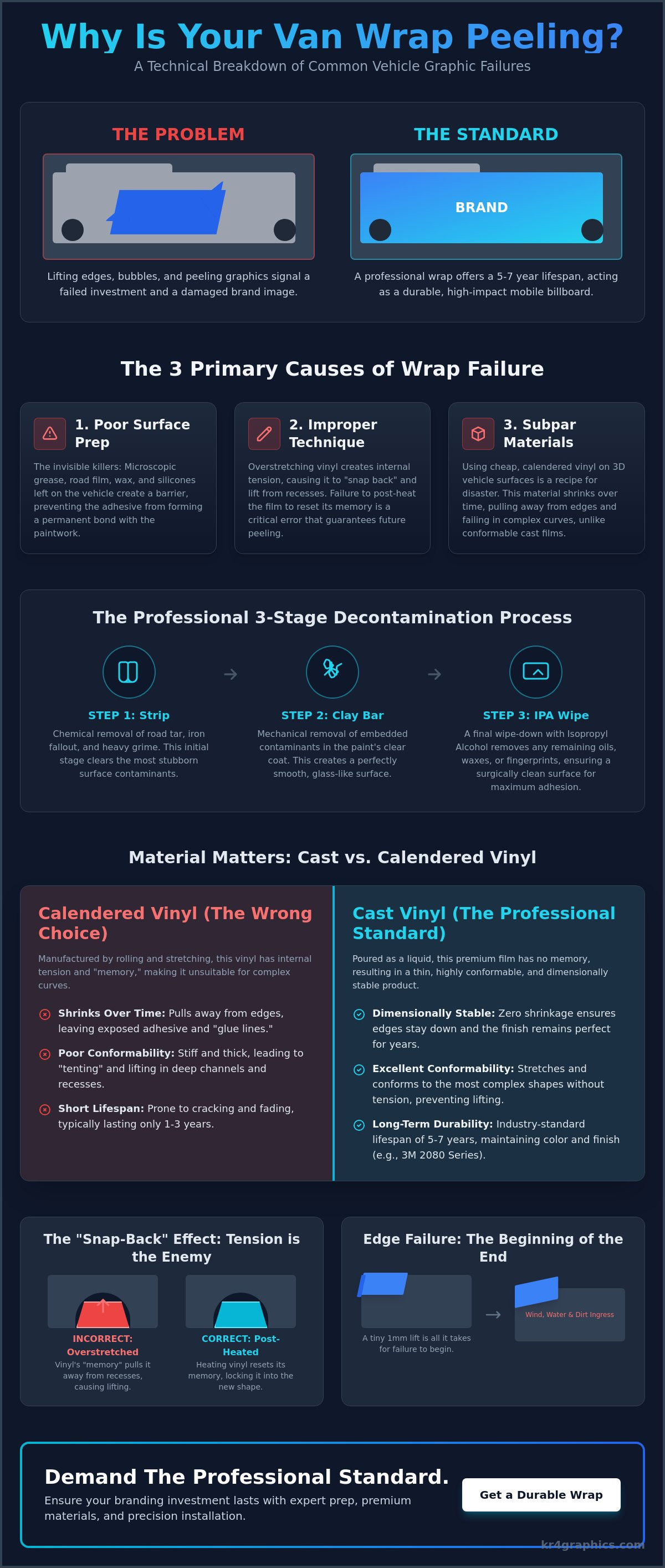
Vinyl possesses a physical memory. It inherently wants to return to its original, flat state. During installation, the film is often stretched into deep channels or around complex curves. If an installer overworks the material, they create massive internal tension. This is a common answer to the question: why is my van wrap peeling in the recesses? The vinyl is literally trying to snap back. This tension eventually overcomes the adhesive's strength, leading to tenting. To prevent this, professional installers use post-heating. By raising the vinyl to a specific temperature, they reset the material's memory to its new shape. Skip this step, and the wrap is a ticking time bomb.
Edge Failure: The Beginning of the End
Edges are the most vulnerable part of any vehicle graphic. A tiny 1mm lift is all it takes for the entire panel to compromise. Once that seal breaks, capillary action draws in moisture, road salt, and dirt. This debris creates a physical barrier that prevents the adhesive from ever re-sticking. At motorway speeds, the problem accelerates. High-velocity wind shear catches these small lifts, acting like a crowbar. It peels the vinyl back with incredible force. This makes tucking and trimming the most vital skills in the workshop. A wrap must be engineered to hide its edges from the elements. Precision trimming ensures the wind flows over the graphic, not under it.
Behind the Surface: How Poor Prep and Cheap Vinyl Kill Graphics
You've seen the physics, but the chemistry beneath the film is often where the real disaster begins. Microscopic grease, wax, and road film are the invisible killers of a high-end branding investment. If you are asking why is my van wrap peeling, the answer usually lies in what happened before the vinyl even touched the panel. A professional wrap requires a surgical environment. A single fingerprint or a trace of commercial tyre shine can ruin the bond. The adhesive needs a pristine surface to achieve its maximum grab. Without it, the wrap is merely resting on the paint, not bonding to it.
The 3-Stage Decontamination Process
A bucket and sponge are not enough. High-impact results demand a rigorous protocol to ensure a total transformation. First, we strip the surface of all road tar and iron fallout. Next comes clay barring. This removes embedded contaminants that a standard wash leaves behind. Finally, we use high-grade Isopropyl Alcohol (IPA) to strip any remaining oils. It is a meticulous process. Many installers skip these steps to save time. They leave behind silicone from commercial car washes or wax from previous detailing. This creates a physical barrier. The adhesive bonds to the grime, not the vehicle. Eventually, that bond fails. If you want a result that lasts, you need a partner who prioritises this precision-driven preparation.
Material Science: Cast Vinyl is Non-Negotiable
The chemical properties of Polyvinyl Chloride determine how a wrap behaves under stress. There are two main types of film: Cast and Calendered. Calendered vinyl is manufactured like pasta, rolled out under pressure. It is thick, stiff, and has a permanent memory of being flat. It works for shop windows, but it's a disaster for vans. Over time, calendered film shrinks as it tries to return to its original state. It pulls away from edges and leaves a nasty "glue line" of exposed adhesive. Cast vinyl is different. It's poured as a liquid. It has zero memory. It conforms to every curve, recess, and rivet without trying to lift. Using cheap calendered film on a 3D surface is a primary reason why is my van wrap peeling in complex areas.
Outgassing is another hidden threat. Freshly painted vans release solvents for weeks. If you wrap too soon, these gases bubble under the film and destroy the adhesive layer. The UK climate adds more pressure. Our damp, cold winters demand high-tack, solvent-based adhesives. High-end engineering accounts for these variables. It ensures your branding remains a strategic asset, not a tatty expense that requires constant repair.
Maintenance Mistakes vs. Installation Errors: Identifying the Culprit
Precision is a binary state. Either your wrap is engineered to last, or it is failing. When you first notice a lifting edge, the clock is already ticking. You need to know: why is my van wrap peeling, and who is responsible? Determining the root cause is a matter of timing and location. If your vinyl begins to lift from a deep recess or swage line within 48 hours of collection, you are looking at a clear installation error. This is a failure of technique, not environment. Conversely, peeling that starts at the very bottom of the sills after a winter season usually points toward road salt and aggressive maintenance. Understanding this distinction protects your investment and your brand's reputation.
The "Jet Wash Death Sentence" is the most common cause of premature failure. A standard industrial pressure washer can hit 3000 PSI. At that force, water becomes a liquid blade. If a nozzle is held too close to a graphic edge, it will force the adhesive layer apart instantly. It doesn't matter how premium the vinyl is; mechanical force wins every time. Similarly, aggressive chemical cleaners are a silent threat. Harsh solvents strip the plasticisers from the film. This turns vibrant, flexible graphics into brittle, peeling flakes that offer zero marketing value.
Signs of Installer Negligence
Bubbles with "fingernail" shapes: These indicate trapped air that was never properly squeegeed out. It is a sign of a rushed job.
Jagged edges: Smooth, precise cuts are the mark of a master. Jagged lines suggest poor blade control and a lack of necessary edge-sealing.
Lifting in deep channels: This is the hallmark of skipped post-heating. The installer failed to "kill" the vinyl's memory, allowing it to pull back to its original shape.
Common Owner Maintenance Pitfalls
Brush car washes: These mechanical monsters are brutal on vinyl laminates. They create micro-scratches that dull your brand and catch on the edges of van sign writing graphics.
Fuel spills: Diesel and petrol act as powerful solvents. A single overflow at the pump can dissolve the adhesive bond around the fuel cap in seconds.
Environmental neglect: Parking under sap-heavy trees or allowing bird droppings to bake in the sun causes rapid degradation. These organic acids eat through the protective laminate and compromise the bond.
A wrap is a high-performance tool. It requires professional handling from the workshop to the wash bay. By identifying these failure modes early, you can take corrective action before a small lift becomes a total replacement. Your fleet should be a catalyst for growth, not a source of constant repair downtime.
Can You Save a Peeling Wrap? Repair vs. Replacement Strategies
Seeing your branding investment lift is a business challenge that demands a fast, high-impact solution. If you are asking why is my van wrap peeling, you are likely looking to stop the bleed before your professional image suffers. Can it be saved? In specific scenarios, a strategic patch is a viable business fix. It prevents further lifting and keeps your fleet on the road. However, you must be realistic about the technical limits of a repair. If the core adhesive has failed due to poor preparation, a patch is merely a temporary mask for a deeper problem.
The "Edge Sealer" myth is a common trap for business owners. Glueing down a failed edge rarely works long-term. Once the vinyl lifts, the adhesive layer is instantly contaminated with microscopic road grit and moisture. Attempting to glue this back down is a futile exercise. You are bonding debris to your paintwork. It will fail again. Often, a partial van wrap is the more cost-effective path. Replacing a single failed panel avoids the massive downtime and expense of a total strip-down while restoring your brand's visual punch.
The Professional Repair Protocol
To save a wrap, the repair must be aggressive. We trim back failed sections until we reach "sound" adhesive that still holds a high-energy bond. This creates a clean, stable boundary. For high-wear areas like wheel arches, we apply specialised edge-sealing tapes to provide mechanical reinforcement against road spray. Colour matching is the ultimate test here. Vinyl fades under the UK's UV exposure. Replacing a single panel on an aged wrap requires technical expertise to ensure the new film blends seamlessly with your existing van sign writing graphics.
Knowing When to Walk Away
There is a definitive point of no return. When peeling becomes a liability, your brand's perceived quality drops. If the vinyl has become brittle or shows signs of "cracking," removal becomes a high-risk operation. Degraded vinyl loses its internal strength, making it difficult to pull off in large sheets. This increases the risk of clear-coat damage during the stripping process. Never wrap over an existing wrap. It is a recipe for immediate double failure. The tension of the new, high-quality film will simply pull the old, failing adhesive right off the substrate. Calculate the ROI of a fresh start. A total transformation is often cheaper than the cumulative cost of constant, ugly repairs. Don't let a failing wrap tarnish your brand's impact; consult our technical team for a professional assessment of your fleet's graphics.
The KR Graphics Standard: Engineering Wraps for West Midlands Roads
West Midlands roads are a brutal testing ground for any vehicle graphic. From the corrosive road salt on the M6 to the relentless cycle of rain and frost, your branding is constantly under siege. If you've spent weeks asking why is my van wrap peeling, the answer often lies in an installer who failed to account for our local climate. At KR Graphics, we don't just apply vinyl. We engineer visual assets to survive the elements. Our 30-year technical heritage in Aldridge means we understand the specific environmental stressors your fleet faces every day. We turn physical assets into high-performance vehicle graphics that act as lead machines for your business.
Total transformation requires more than just a creative eye. It demands industrial durability. We treat every project as a strategic investment. Our goal is to ensure your brand projects scale and professional competence from day one to year five. By focusing on tangible quality and technical precision, we eliminate the risks of premature failure and unprofessional downtime. Your fleet should be a catalyst for growth, not a source of constant repair costs.
The Flawless Finish Process
Precision starts in the workshop. We never wrap in cold, damp, or uncontrolled environments. Temperature-controlled application is non-negotiable for achieving a permanent bond. Our team uses infrared thermometry to monitor the post-heating process with surgical accuracy. This ensures the vinyl's memory is completely reset, preventing the lifting and tenting discussed in previous sections. We specialise in premium full vehicle wraps using only high-performance cast films from industry leaders. This commitment to materials ensures your graphics remain vibrant and secure, regardless of the weather.
The Local Advantage
Being based in Aldridge gives us a distinct edge. We provide rapid aftercare and dedicated support for West Midlands construction and retail fleets. Our 30-year track record is built on reliability and results. We understand that your vehicles need to be on the road, not sitting in a repair bay. When you partner with us, you aren't just buying a service. You're gaining a partner obsessed with your brand's longevity. Ready for a wrap that actually lasts? Get a high-octane quote from KR Graphics today. We build graphics for businesses that refuse to settle for second best.
Secure Your Brand’s Mobile Legacy
Your vehicle is a powerful marketing tool. It should act as a catalyst for growth, not a source of constant frustration. We've uncovered the technical truth behind vehicle graphic failure. You now understand that physics, material science, and surgical preparation dictate the lifespan of your branding. Whether it's managing vinyl memory or choosing high-performance cast films, every detail matters. You no longer need to wonder why is my van wrap peeling when the answer lies in precision engineering and climate-specific application.
At KR Graphics, we bring over 30 years of Aldridge expertise to every project. We're the trusted specialists for West Midlands commercial fleets. We use only high-performance cast vinyl to ensure your investment survives the rigours of the road. We don't just provide a service; we deliver a total transformation that projects scale and professional competence. Take control of your fleet’s image today.
Stop the peel and start the transformation; get your pro wrap quote now
Your brand's about to undergo a massive, high-quality change. Let’s build an asset that reflects your success and drives your business forward for years to come.
Frequently Asked Questions
How long should a professional van wrap actually last?
A professionally installed van wrap using high-performance cast vinyl typically has a life expectancy of five to seven years. This lifespan assumes proper maintenance and the use of premium materials like the 3M 2080 or Avery SW900 series. Cheaper calendared films will fail much sooner. If your graphics are lifting within months, you are likely looking at a material or installation flaw rather than natural wear.
Can I jet wash my wrapped van if it starts peeling?
Avoid jet washing at all costs if you notice any lifting. Mechanical force at 3000 PSI acts as a liquid blade. It will catch the loose edge and strip the vinyl from the panel instantly. Stick to low-pressure hand washing to prevent further degradation. Once an edge lifts, high-pressure water is the fastest way to turn a minor repair into a total replacement.
Will a peeling wrap damage my van's original paintwork?
Peeling vinyl rarely damages original factory paint directly. However, the failure allows moisture and road salt to sit against the substrate. This trapped debris can lead to paint degradation over time. Brittle, failing vinyl also becomes significantly harder to remove safely. Prompt action is essential to protect your vehicle’s resale value and ensure a clean strip-down later.
Why is my wrap peeling specifically around the door handles?
Door handles are complex, high-contact areas prone to failure. You might ask why is my van wrap peeling here specifically. It is often a combination of overstretched vinyl and contamination from skin oils. These oils weaken the adhesive bond on curved surfaces. Precision trimming and thorough decontamination during the initial install are the only ways to prevent this specific failure point.
Is it possible to fix just one peeling panel without redoing the whole van?
You can replace a single failing panel without a total strip-down. This is a common strategic fix for commercial fleets. It minimises downtime and saves on costs while restoring your brand's professional image. The only challenge is colour matching. Older wraps may have faded slightly due to UV exposure. A skilled technician will assess if a new panel will blend seamlessly with your existing graphics.
Does the UK weather make van wraps peel faster than in other countries?
The UK’s climate is particularly harsh on vehicle graphics. Constant rain, winter frost, and heavy road salting create a corrosive environment that attacks adhesive edges. These conditions demand a climate-specific approach to installation. We use high-tack, solvent-based adhesives and precise edge-sealing to ensure your branding survives West Midlands roads. Standard application techniques used in drier climates simply won't cut it here.
What is the best way to clean a wrapped van to prevent edge lifting?
Hand washing with a pH-neutral shampoo is the gold standard. Use a soft microfibre mitt and avoid scrubbing the edges of the graphics. Never use aggressive chemical cleaners or mechanical brush car washes. These systems catch on vinyl edges and cause rapid lifting. Drying the edges with a clean microfibre towel prevents water from sitting under the film, ensuring long-term adhesion.
Can I claim on a warranty if my van wrap starts peeling after six months?
Warranty claims depend entirely on the root cause of the failure. Most reputable installers provide a guarantee against installation errors, such as lifting in deep recesses, within the first twelve months. However, warranties rarely cover mechanical damage from jet washes or chemical neglect. Check your specific agreement. If the failure is due to poor preparation or cheap calendered film, a professional partner should stand by their work.


Comments