
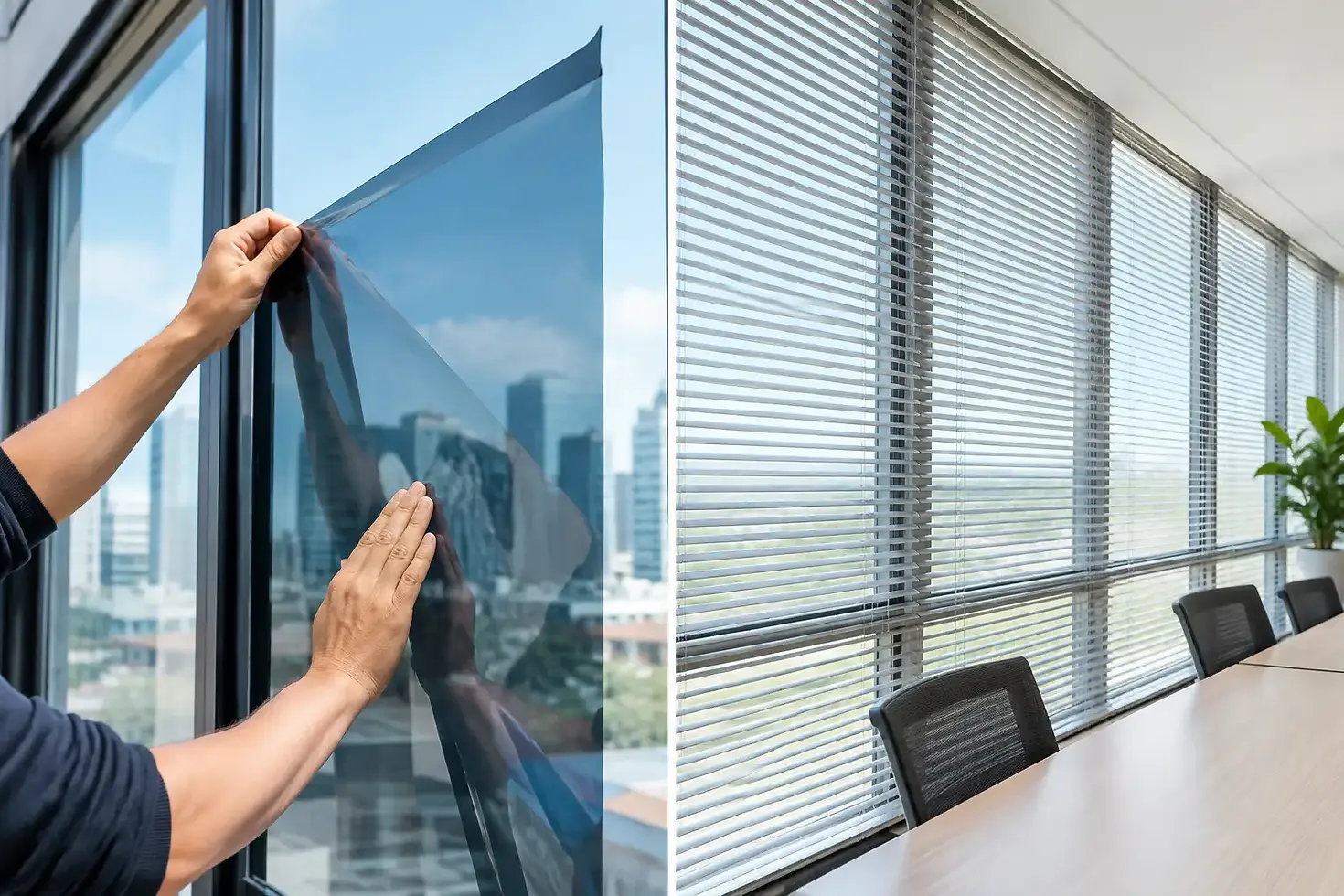
Solar Film Versus Blinds for Commercial Windows

A west-facing office window can turn a productive meeting room into a hot, glare-filled space by mid-afternoon. Choosing between solar film versus blinds is not simply a question of appearance. It affects staff comfort, energy use, privacy, cleaning routines and the way customers see your premises from the street.
For commercial properties, the right answer depends on what the glass needs to do. Blinds give occupants direct control over light and privacy. Solar-control window film works continuously, reducing solar heat and glare without covering the view or adding another moving part. In many business settings, it is the more practical long-term choice. In others, a combined approach earns its keep.
Solar film versus blinds: the practical difference
Solar film is a specialist layer applied directly to existing glazing. Depending on the product selected, it can reject a significant proportion of solar energy, cut glare, filter UV light and add a more uniform external finish to the building. Once professionally installed, it remains in place and works every day without staff needing to adjust it.
Blinds sit inside the room and create a physical barrier between occupants and daylight. Venetian, roller and vertical systems all provide varying levels of light control, and blackout blinds can make a room suitable for presentations or screen-based work. Their strength is flexibility: open them when the weather is dull, angle them to redirect light, or close them fully when privacy is needed.
The key distinction is where the heat is managed. Solar film tackles much of the sun's energy at the glass. Blinds reduce brightness inside the room, but the sun may already have passed through the glazing and heated the space. That difference matters in offices, retail units, reception areas and glazed meeting rooms that become uncomfortable on sunny days.
Where solar film delivers the stronger result
Solar film is particularly effective on large areas of glass with consistent exposure. Think south- or west-facing offices, showroom frontages, shop windows, healthcare waiting areas and meeting rooms where glare disrupts screens. It reduces the need for people to pull down blinds during the brightest part of the day, helping premises remain lighter and more welcoming.
It also protects furnishings, displays and printed graphics from UV exposure. Sunlight can fade upholstery, merchandise, flooring and display materials over time. Film will not eliminate every effect of daylight, but it can materially reduce the UV reaching the interior and help costly fit-outs look better for longer.
From an operational viewpoint, solar film has another advantage: it does not rely on user behaviour. A blind left open at 2pm does nothing for glare or heat. A correctly specified solar film is always working, whether the building is occupied or not. For facilities teams managing several rooms or sites, that consistency is valuable.
Solar film can also support a cleaner frontage. Certain finishes provide daytime privacy or a more discreet appearance while retaining useful visibility from inside. However, this needs careful specification. Highly reflective film may suit some commercial elevations but can make others feel too closed off, particularly retail premises that rely on an open, approachable shopfront.
When blinds are the better choice
Blinds are hard to beat when full darkness or changing privacy is the priority. Boardrooms used for presentations, training rooms with projectors, clinical consultation rooms and ground-floor offices facing pedestrian areas often need control that can be altered minute by minute. A blackout blind offers something solar film cannot: near-complete light exclusion when it is lowered.
They can also be the sensible option where daylight is limited for much of the year. A north-facing room with occasional privacy concerns is unlikely to need a heat-rejecting film. A good roller blind may solve the real issue at a lower initial cost.
Design choice is another reason businesses choose blinds. Fabric colours, textures and cassette systems can be matched to an interior scheme, while printed blinds can carry messaging in selected environments. The trade-off is that they are visible inside the space, collect dust and require regular adjustment, cleaning and occasional repair.
Heat, glare and energy costs
If overheating is the central complaint, solar-control film should be assessed first. Blinds can make a room feel more comfortable by reducing direct light, but they are usually a secondary measure for solar heat. In heavily glazed buildings, reducing heat gain at the window can ease pressure on air conditioning and help create a more consistent working temperature.
That does not mean every film delivers the same performance. The construction of the glazing, the direction it faces, surrounding shade, room use and existing HVAC system all affect the result. A dark-looking film is not automatically the best thermal choice, and a light or neutral film may offer a better balance of heat rejection and visible light transmission.
Glare needs the same level of thought. Computer screens, point-of-sale terminals and digital displays all respond differently to changing daylight. A suitable film can soften the harshest light while keeping the outside view. Blinds may provide greater control at certain times, but they can also leave staff working in a darker room with the view blocked.
Privacy, security and the view out
Businesses often ask for privacy when they actually need one of several different solutions. Daytime solar or reflective film can make it harder to see into a glazed office from outside when the exterior is brighter than the interior. At night, the effect can reverse if internal lights are on. Blinds, curtains or an additional privacy treatment may still be needed after dark.
For permanent privacy, frosted or printed manifestation film is generally more predictable than solar film. It can cover a lower band, full panel or selected areas of a glass partition while allowing daylight through. This is useful for meeting rooms, treatment spaces and internal office glazing where confidentiality matters.
Neither standard solar film nor blinds should be treated as a security product. Security window film is a separate specification designed to help hold fractured glass together. Where safety, impact resistance or compliance is part of the brief, the glazing and film system must be assessed properly rather than relying on a visual solution alone.
Branding and appearance at the window
Commercial windows are valuable visual real estate. Blinds can make an interior look orderly, but when they are closed they can create a blank, uninviting frontage. Solar film keeps the glass surface cleaner and more consistent, which can work well alongside vinyl graphics, opening-hours information and branded manifestation details.
There is a practical limit. Applying graphics over certain solar films, or fitting film to older sealed units, needs the correct material choice and installation method. Heat absorption, glass type and warranty conditions all matter. A professional survey avoids the familiar problem of a good-looking idea causing stress on the glass or failing prematurely.
For multi-site businesses, consistency is often the deciding factor. The same film tone, opacity and graphic layout can be repeated across offices, depots and retail locations, helping customers recognise the business before they step through the door. KR4 Graphics can coordinate window-film specification, branded graphics and installation as one managed project, rather than leaving different contractors to interpret the brief.
Maintenance and lifespan
Blinds are relatively simple to replace, but they have moving parts. Cords, chains, slats and brackets can be damaged, particularly in busy shared spaces. They also attract dust and can become difficult to clean in kitchens, workshops, healthcare settings and customer-facing environments.
Solar film has no operational parts and requires only sensible cleaning once cured. Its lifespan depends on the film grade, glazing condition, orientation and exposure. Quality commercial products installed on suitable glass are intended to be durable, but film is not fit-and-forget if the glass is later damaged, altered or replaced.
The installation itself is decisive. Poor preparation can leave contamination, lifting edges or uneven finishes that undermine the appearance of the whole elevation. Correct measurements, clean glass preparation and careful edge finishing are what make the difference between a window treatment that looks temporary and one that looks part of the building.
Making the right call for your premises
Choose solar film when your main goals are reducing heat, glare and UV exposure while keeping a clear, professional-looking window. Choose blinds when rooms need adjustable privacy, presentation darkness or occasional light control. Use both where staff need solar protection throughout the day but also require full blackout or privacy at selected times.
Before ordering either, look at the window orientation, glass type, room use and the view from both sides of the building. A site survey turns a broad preference into a specification that will perform properly. The best window solution is the one that keeps people comfortable, protects the space and makes your premises look like a business that means business.


Comments